


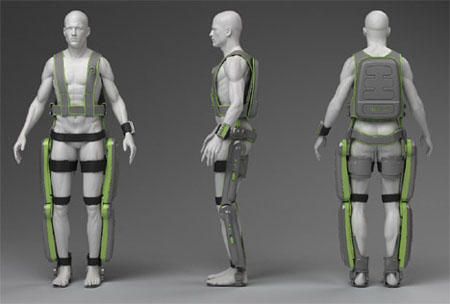
To stand and to walk for some people that could be just a dream. ReWalk exoskeleton is trying to make that dream come true, paraplegics will be able to stand, walk, even climb the stairs The challenge here is to design something that imitates a human walking, including universal fit for a broad range of user height and weight measurements, as well as a low profile that is both contemporary and user friendly. ReWalk exoskeleton is a light, wearable brace support suit featuring DC motors at the joints, rechargeable batteries, an array of sensors, and a computer-based control system. Users wear a backpack device and braces on their legs, and select the activity they want from a remote control. A sensor on the chest determines the torso’s angle and guides the legs to move forward or backward to maintain balance. You can expect to see ReWalk Exoskeleton on sale in 2009.
PS : Finally, U.S. Food and Drug Administration has cleared the company’s ReWalk Personal System for use at home and in the community.
Designer : Argo Medical Technologies




I like this product, if sold, then please let me know
Hi,
Could you please advise if you have something for a paraplegic arm.
I am a quadraplegic.I have been injuried since,1985.I am paralized from the chest down,but I have very strong arms(triceps),but can not move my fingers.Would I be able to use the ReWalk?
I am very interested in the exo-skeleton for daughter, a 22 year old brain injury survivor. She had trauma to her motor cortex so it makes it difficult to walk due to some spasticity. She is continually building new pathwys through repetition at home and can walk somewhat with help. I feel she will need some type of modality to assist her left side in order to continue the improvement and would love to know if this might just be the help she needs. I think it is wonderful that it is being developed and we are a "for sure" when it does arrive!
Exciting development. As a post-polio now in the Late Effects of Polio stage with ever diminishing mobility in lower limbs, this appears to be just what is needed to keep a wheelchair at bay. Please keep informed of further advances. I would gladly help in any trials in Europe. Keep up the good work.
Edward Long
i have spina bifida would this be something for me to be able to do?
i am interested in buying a re-walk because i have been in a wheelchair almost my whole life and ya know what man.
interested in more information about the exokeleton. ny brother is paraplegic
where can i buy a eksoskelt and what is the price?
where ca I buy it and for how much?
my query is the same as above…..where can i buy it and for how much….
i'm indian girl paraplegic from chest below…..plz lemme knw….tks
hi im a t8 t9 para got nothink from belly down has same one got the exo skelton yet if so were from l would lov to give it a go n how much thank
I need your system in South Africa please contact me for price and delivery
My wife is paraplegic and want more details about esoskeleton. Kindly let us know the price and its availability
Hi i am saravanan.i am poli patient i like to use robotic legs .i like to buy ur re walk product pls send the price and address to this mail id [email protected]
hi I am polio patient I need your device kindly send me details about your price and delivery in Pakistan at [email protected]
Is this product for sale now? If this is in production, can you kindly send me info about it. Price and where to get it from. My email is [email protected]
We're in Australia Victoria can you try the ? Easy walk machine please
Hi I'm T2 paraglegic from South Africa, where can I find the machine?