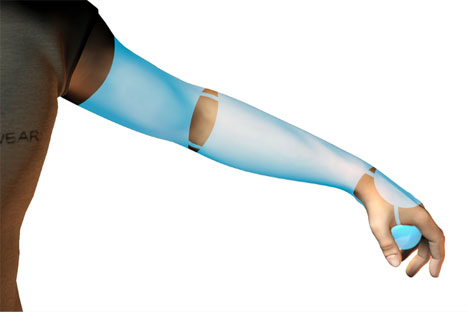


Do you know that in the USA alone, approx. 150,000 people die from stroke annually? Stroke is also the leading cause of serious long term disability. Around 1/3 of stroke patients suffer from hyperthermia which is an abnormal increase in body temperature. Otivia is a conceptual medical device specifically designed to cool down and stabilizing body temperature of stroke patients suffering from hyperthermia. It works by increasing blood flow in the arm while at the same time drawing heat from it. The blood flow in the arm alone is enough to cool down the entire body, avoiding abnormal fever and other dangers associated with it.
Designer : Bilal Zia Chaudhry
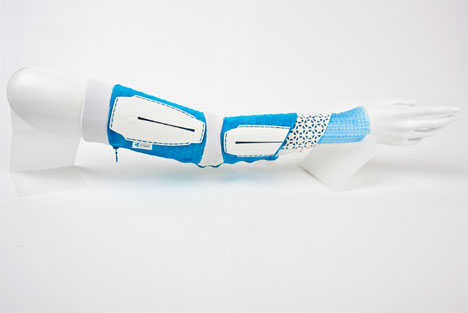
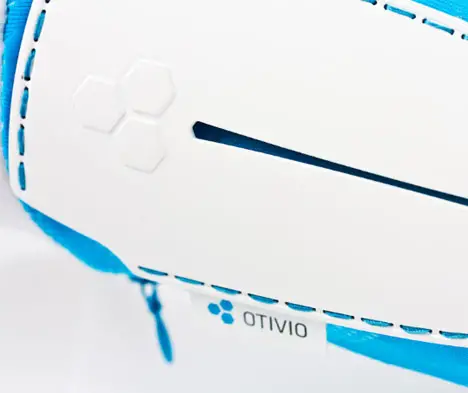
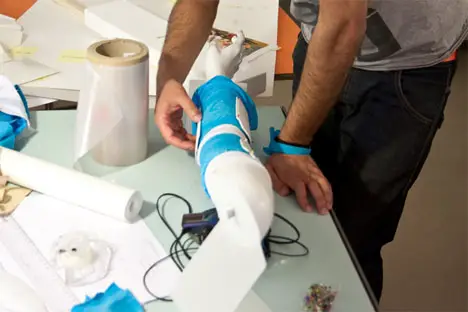
The arm unit Otivio prevents hyperthermia in stroke patients, reducing mortality and disability. This is accomplished by cooling down and stabilizing the body temperature over a 24-hour period after the stroke patient arrives at hospital. The unit consists of two main components: a disposable glove and an outer shell. Temperate water circulates in the disposable glove while negative pressure is generated in the outer shell. The pulsating pressure expands the veins in the patient’s arm. This increases skin blood flow locally, while the water acts as an effective heat-transfer medium. Treating just the arm can cool down the entire body.
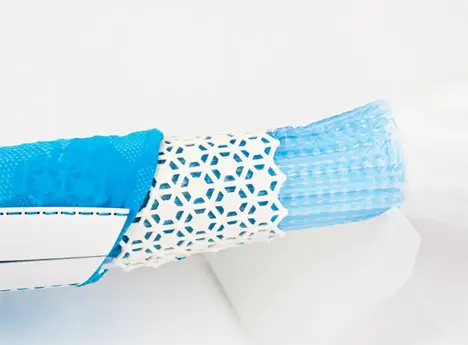
Patient rehabilitation is dependent on early physical movement, so flexibility is a necessary quality of Otivio. The layered disposable glove allows for a controlled amount of water to flow through a predefined pattern, which reduces the amount of water required and thereby reduces weight. The device also needs to be airtight and stiff enough to withstand the generated pressure, yet it must also allow movement. Otivio’s mesh structure covered with a sealing textile satisfies these requirements.
Otivio is connected to an external control unit with two small tubes providing continuous temperate water flow. The control unit is also responsible for generating the pulsating pressure.